
aeroplane mode: where does a story begin?
she's asking questions
Hello,
This is Aeroplane Mode, a very sporadic newsletter with links to my published work on wildness, anti-productivity, and having a body in the world.
I recently began an “artist pen pals” correspondence with a friend (inspired by Homework Club), and in my first letter, I wrote to her that whenever I thought about starting another book, I felt utterly trapped: the idea that I would have to crawl back into a niche and stay there for years. In fact, after my first book came out in 2018, I almost entirely stopped writing for years. This had to do partly with grief and fear in my life, but also because I was no longer interested in the topics I had been working on: the freelancer’s niche felt like a cage. I wasn’t sure what I was interested in, but staying within a gender/sex/tech beat wasn’t going to help me find it.
What I have found is that I like the freedom of writing as non-specialist. I can write about pine trees and moss without being an ecologist, and excavating my relationship with doctors without being a memoirist. I can go deep into a topic and emerge after several months, and then switch it up completely the next time around. I used to go after mastery, but for now, I’m happy to be led by my interests: a Jane of all trades, master of none.
Why am I telling you this? Well, other than having to tell you something in a newsletter, this year my interests led me down an especially winding path. I spent months writing a twisting and turning, criss-crossing essay for Hazlitt called Land of Five Rivers. I didn’t know where it would end, and now that it’s done, I’m not sure where it began. Some possibilities:
in 2022, Pakistan experienced some of the worst floods in human history, leaving me frozen in horror
last year, my mum made a throwaway comment about Pakistan’s major rivers coming through India
in the year 2000, one of my favourite people died
Where do stories begin? Your guess is as good as mine.
Richa x
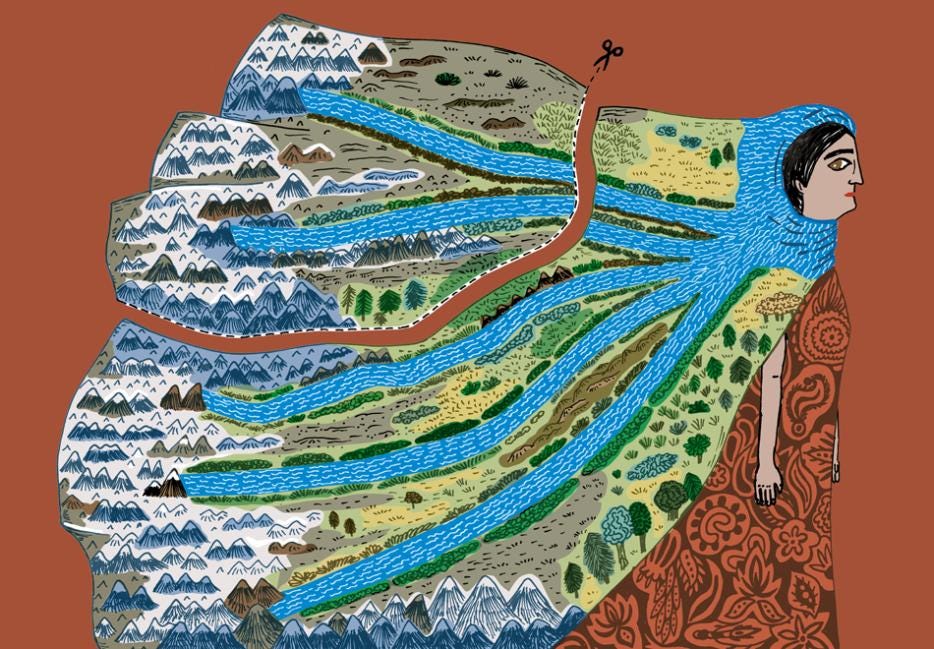
My nani was born in Lahore. As a child, whenever I stumbled upon this fact, shelved neatly away in my mind, I would pick it up gently, like a dark gleaming jewel, examining it from all sides. What made the stone precious I couldn’t exactly say, but I didn’t doubt its value. It had a distinctive sheen. But then again, so did many things about Nani.
When I was young, Nani—my mother’s mother—was the grandparent I gravitated toward. For an “old” person, she seemed the least old. She frequented cinemas, often alone, for every “mirch-masala” Hindi film released, and bought me their cassette soundtracks for my Walkman. Banned from Bollywood myself till a more suitable age, I would hang on to her every word as she detailed the plots.
During summer holidays, Nani would take me in autorickshaws to the library near her North Bombay apartment, where I would stock up on Sweet Valleys and she would buy bindis from the neighbouring store. A chain smoker all her life (which was neither common nor respectable for women of her generation), she would spend inordinate amounts of time on her tiny fourth-floor balcony, from which, in the distance, the Arabian Sea was visible. She wore variously patterned silk and cotton saris, and equally vivid lipstick. One of my childhood best friends and I have always maintained that the only person who could pull off scarlet lipstick was Nani Kaul.
Why, then, given Nani’s dazzling persona, was it her place of birth that persisted in my mind? After all, to be born in Lahore in 1934 was simply a fact. But by the time I was my nani’s granddaughter in the ’90s, it felt more like a myth.
Read the rest of my essay Land of Five Rivers for Hazlitt here.
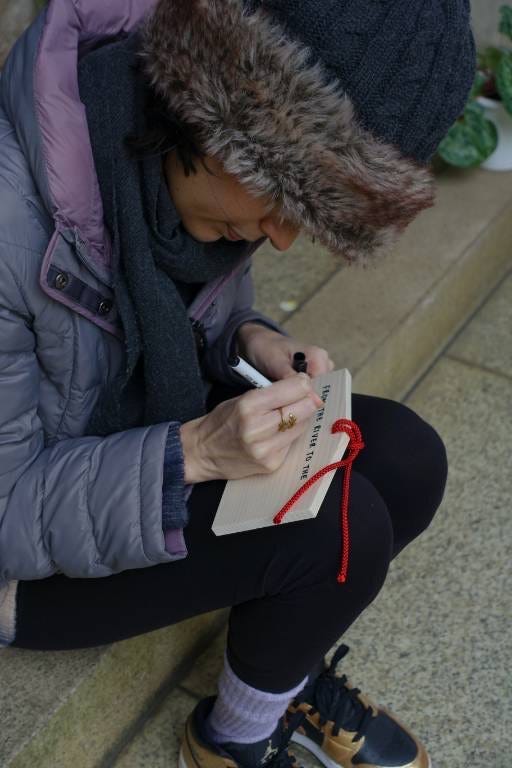
Religion has always been the justification for colonialism; its handmaiden and battle cry rolled into one. The ‘civilising’ of cultures around the world was done in the name of European Christian morals. Why else are countries from Kenya to Myanmar to India littered with 150 year old churches and devout local communities? It was seen as a moral duty: to spread the word of God. In Goa, where I live, Portuguese rulers broke every temple they could find: there is only one still standing, deep in a forest, in the entire state. But of course, colonialism was never about religion. It was about the extraction of resources and the enslavement of local populations, for ecomonic and political gain. Religion was the moral rationale for empire: its shiny, righteous coat. Underneath, something was rotten in the state of Denmark. Literally.
Let’s say we now know this. We ie the broad left, we who are decolonising our thinking and doing land acknowledgments. We know that it wasn’t about religion. In fact, the idea that anyone ever believed it was about religion feels apalling to us. Religion my arse, unless your religion is smallpox blankets. We know this, right? RIGHT?
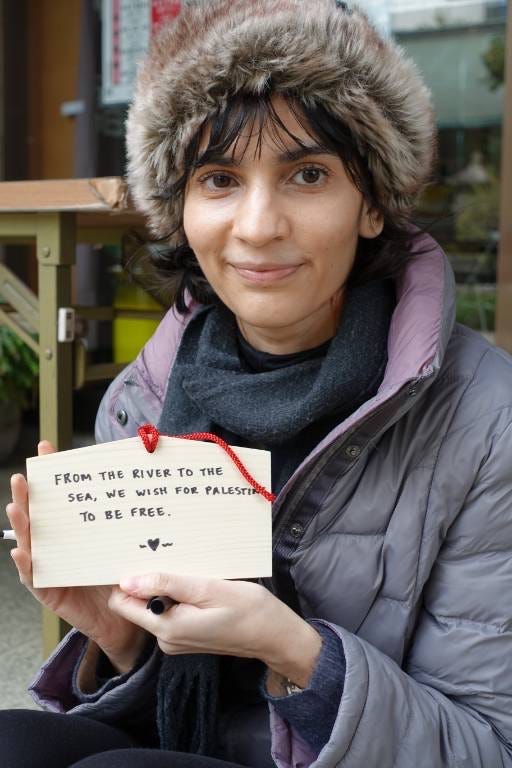
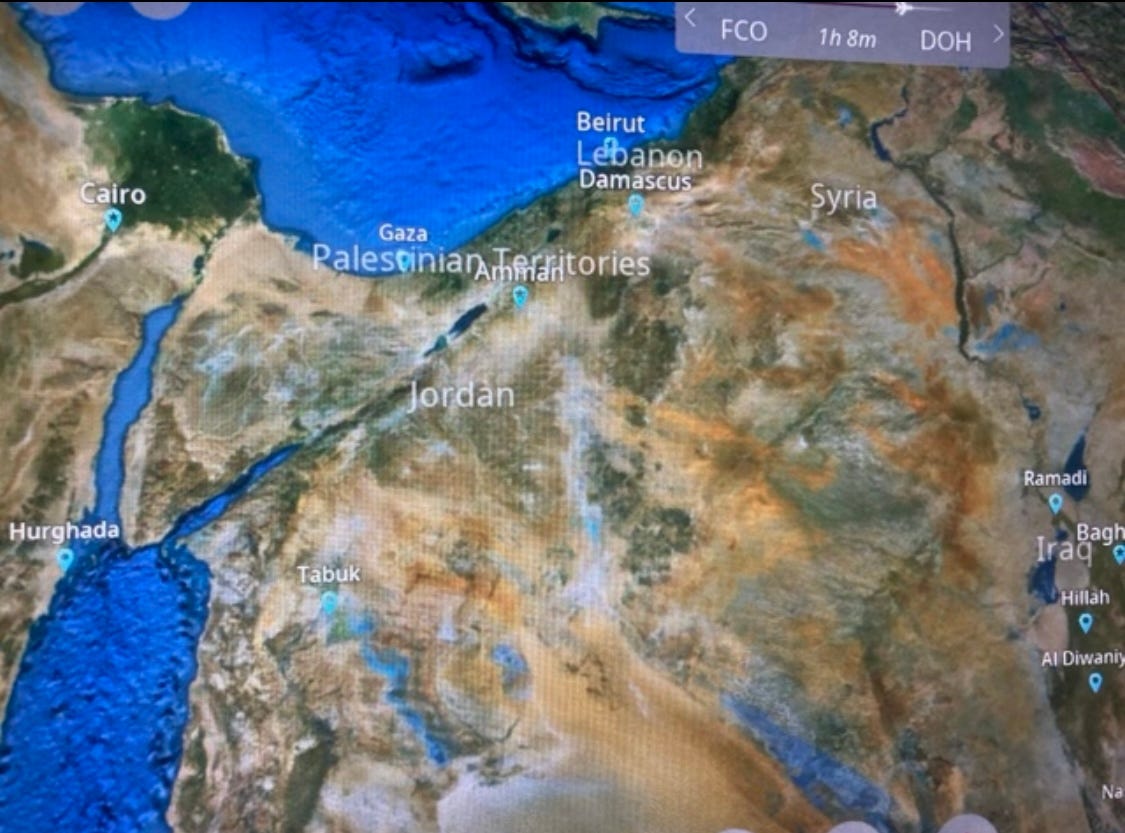
Because thing I find apalling, other than the unspeakable reality on the ground, is that ten months into a livestreamed genocide in Gaza and a ramping up of both settler and state violence in the occuped West Bank, is that this is still being positioned as a matter of religion. That the resistence of indigenous Palestinian people to 75 years of settler colonialism, is still seen as an attack on the Jewish faith. That the actions of the Israeli state, not just over the past nine months but since its inception, its denial of Palestinian rights to land, water, homes and free movements, are acts of faith.
Two days ago the highest court in the world, the International Court of Justice, declared the Israeli occupation of Palestine to be apartheid. Apartheid. While I was watching the court ruling on TV, the news ticker below said that the polio virus had been found in Gaza’s sewage. Polio.
In my last newsletter, I said that in 2007, it was Palestine that radicalised me. It was the first political issue that made me go out into the streets and protest. Occupy a building, pick up a megaphone, put my body on the line. It changed me.
But where do stories begin? As I sat down to write this newsletter today, I got a message from my friend Mercy, who I’ve known since I was ten years old.

Oh, to be an arrogant teenager again! But I also feel weirdly proud (?) that 14 year old me, growing up on a tiny mountaintop with barely any internet connection, only having left India once in my life, knew that something was very very wrong, somewhere very far away.
And while clearly I won’t be the one to implement it, I do think there is a solution. This 87 year old Holocaust survivor says it best.
Other things:
Remember Freakonomics, the maverick bestseller? Should I have…actually read it? Can economics be…useful? If Books Could Kill has the answers.
Are trans kids a new phenomenon? Is astrology a better option than a gender reveal? If you want to do right by the kids in your life, Gender Playground is the place to be.
What makes a genocidal mind? One of the best pieces I’ve read all year.
It’s been so long since I wrote this newsletter last that I can’t even begin to list the books I loved, but here are a paltry few: Butter by Asako Yuzuki is the first Japanese novel I’ve seen explicity name misogyny, and I was absolutely living for it. Speaking of Japanese, Butter’s translator, Polly Barton, has a wonderful book called Fifty Sounds about language, learning Japanese and what it means to belong to a place. And lastly, Enter Ghost by Isabella Hammad was one of my favourite novels of the year. A story about staging Hamlet in the West Bank? Yes please.
TV, my other love, continues to delight me. Lately I’ve thoroughly enjoyed The Traitors (UK), Giri/Haji, This Way Up and The Gold. They’re all British, so if you’re outside the country, you’ll likely need a good VPN or a pirate ship.
I edited (most of) a book! And They Lived…Ever After (HarperCollins India) is a collection of fairytales retold from the perspective of disability by Indian disabled women. The typos, I feel compelled to add, belong to the publisher’s pen and not mine.
Recap:
The Land of Five Rivers, my essay on colonialism, Partition, the climate crisis and my nani, is over on Hazlitt here.
My name is Mohan Krishnan. Am trying to get in touch with Anjali whom I knew ages ago, we did amazing work together. Could you please help. You write mindfully and mind blowingly. WhatsApp 9820961022.